Article Summary:
Gold beneficiation plants feature a uniquely challenging cost structure: grinding mills consume the majority of plant electricity, while gold recovery rates depend heavily on precise grinding fineness. The mission of fine-crushing equipment in gold processing is clear—compressing ball mill feed size to the minimum to relieve downstream milling loads. This article explores why double roll crushers are the premier recommendation for gold ore fine crushing, highlighting their role in “more crushing, less grinding,” stable mill feed sizing, slime prevention, low consumable wear, and hydraulic protection.
Gold beneficiation plants feature a uniquely challenging cost structure: grinding mills consume the majority of plant electricity, while gold recovery rates depend heavily on precise grinding fineness. The mission of fine-crushing equipment in gold processing is clear—compressing ball mill feed size to the minimum to relieve downstream milling loads. This article explores why double roll crushers are the premier recommendation for gold ore fine crushing, highlighting their role in “more crushing, less grinding,” stable mill feed sizing, slime prevention, low consumable wear, and hydraulic protection.
The cost structure of gold beneficiation lines is exceptionally distinct: grinding circuits consume well over half of the entire plant’s electrical power, while gold recovery is critically dependent on grinding fineness. Consequently, the mission of gold ore fine-crushing equipment is unequivocal—compressing mill feed sizing to the absolute minimum so that grinding mills perform less heavy lifting. For this vital link, our definitive recommendation is the double roll crusher.
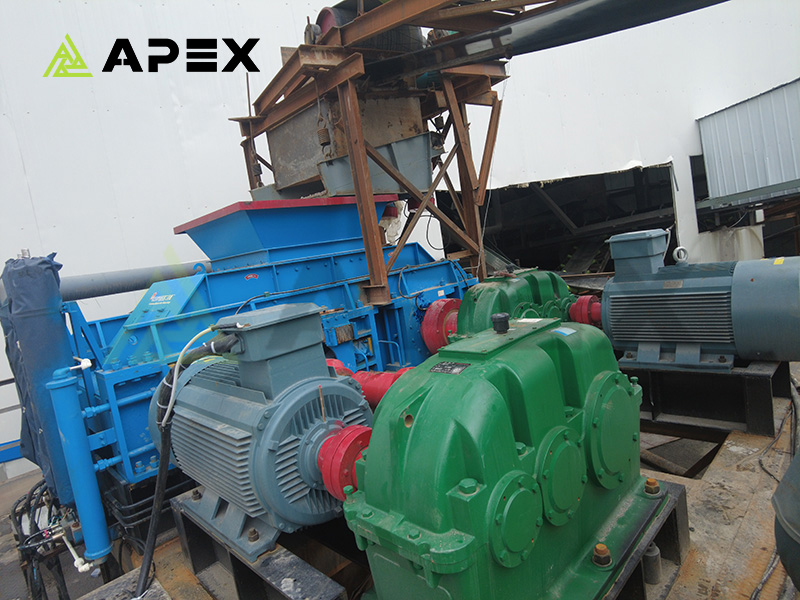
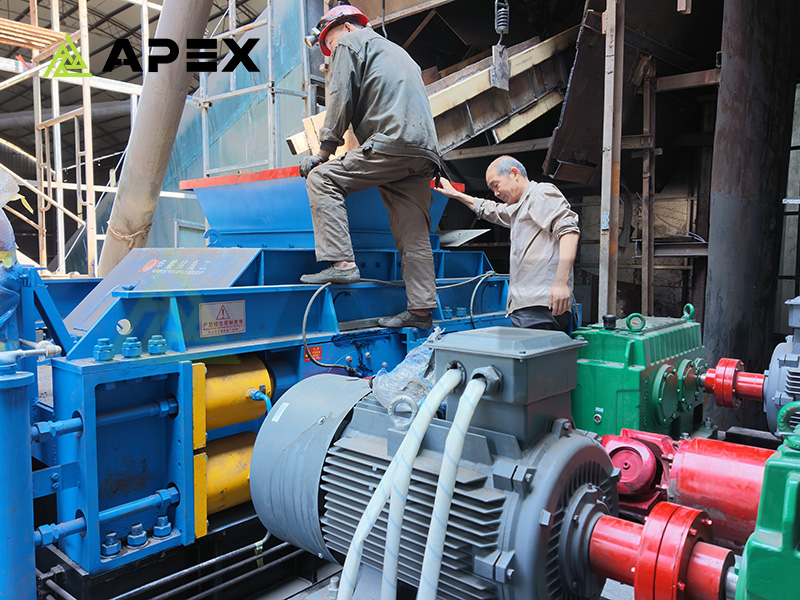
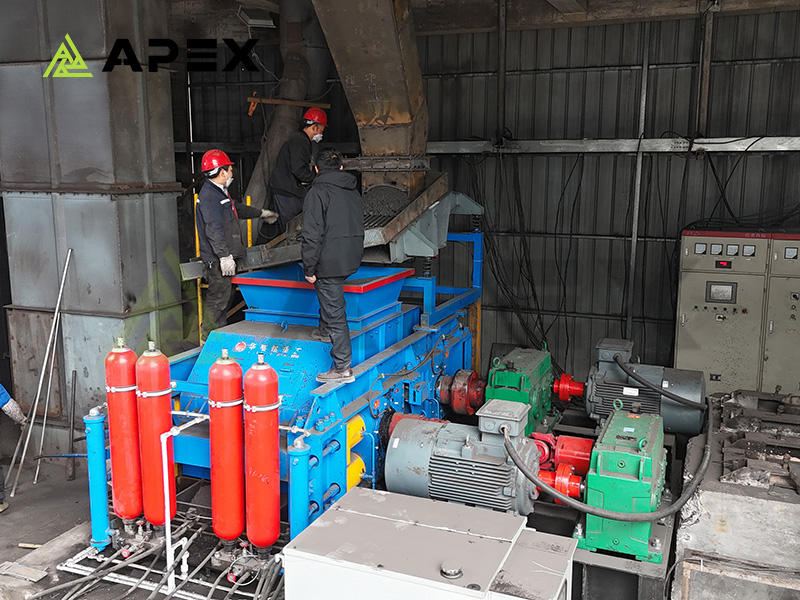
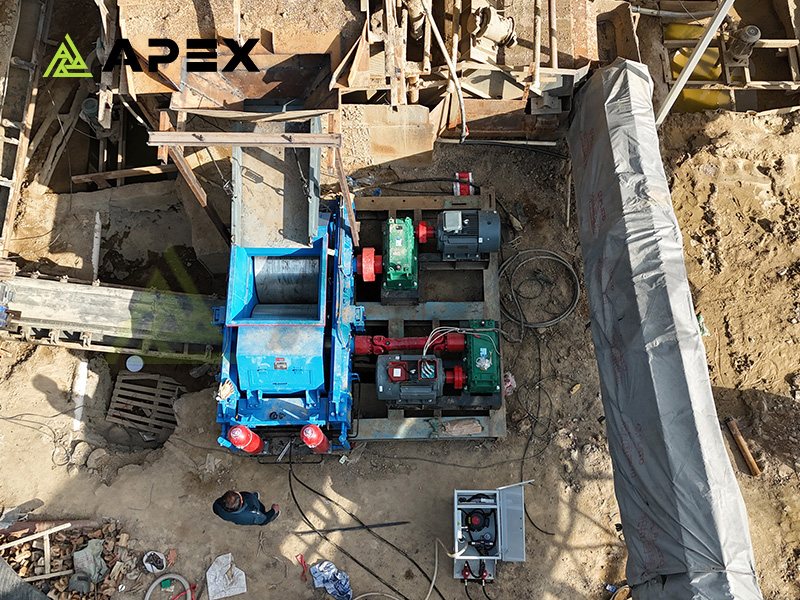
Apex Hydraulic Double Roll Crusher Operating in a Gold Ore Processing Plant
1. Core Advantages of Double Roll Crushers in Gold Beneficiation
| Gold Plant Advantage | Engineering Mechanism | Operational & Economic Value |
|---|---|---|
| 1. “More Crushing, Less Grinding” | Significantly reduces mill feed sizing prior to downstream ball milling circuits 【Custom Parameters Available】. | Finer mill feed increases ball mill throughput and cuts electricity consumption—delivering daily savings for gold plants. |
| 2. Stable, Adjustable Sizing | Precision inter-roll gap adjustments maintain consistent, predictable top-size limits. | Prevents surging particle sizes from destabilizing ball mills, keeping grinding fineness and processing capacity steady. |
| 3. Low Over-Crushing (Slime Prevention) | “Sufficiently crushed, immediately discharged” static compression logic. | Minimizes ultra-fine slimes that waste energy and interfere with downstream flotation or gravity recovery (“preventing gold loss”) 【Custom Parameters Available】. |
| 4. Minimal Consumables & High Uptime | Lacks high-frequency hammers or thrower tips; utilizes durable, even-wearing roller shells. | Meets continuous gold plant production demands by eliminating frequent maintenance stoppages and production losses. |
| 5. Hydraulic Tramp Protection | High-response hydraulic accumulators allowing movable rolls to retract and reset. | Safeguards against underground drill bits and stray steel fragments, preventing shell cracking and main shaft damage. |
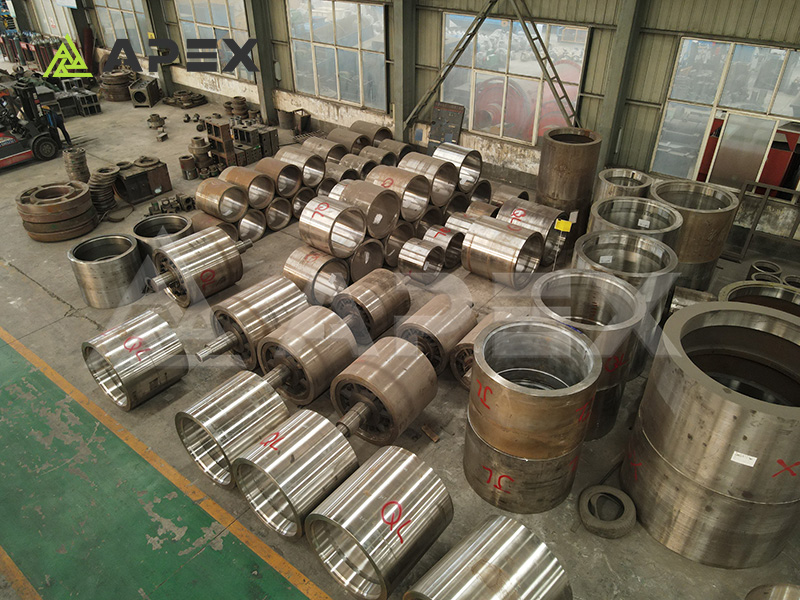
High-Chromium Roller Shells
2. Standard Proven Gold Ore Flowsheet
Standard Multi-Stage Circuit:
Vibrating Feeder $rightarrow$ Jaw Crusher (Primary Coarse Reduction) $rightarrow$ Cone Crusher (Secondary Medium Reduction) $rightarrow$ Double Roll Crusher (Fine Reduction & Sizing) $rightarrow$ Circular Vibrating Screen (Closed-Circuit Oversize Return Loop) $rightarrow$ Fine Ore Bin / Grinding Ball Mill.
- Strict Feed Sizing Control: Maintain feed lump sizes within model limits (ranging from 25mm to 120mm by model), leaving massive run-of-mine boulders to the primary jaw crusher.
- Closed-Circuit Screening Integration: Equip the fine-crushing stage with vibrating screens and oversize return loops to guarantee uniform mill feed sizing.
Capacities range from compact models for small-scale mountain gold operations (e.g., 2–20 TPH) up to high-capacity heavy-duty industrial concentrators, with hard quartz gold ores uniformly equipped with high-chromium wear-resistant roller shells 【Custom Parameters Available】.
3. Frequently Asked Questions
Q: Gold ore hardness varies significantly; how should roller shells be selected?
A: Oxide ores and weathered ores are relatively soft and can be processed with standard wear-resistant roller shells. Native quartz ores with high free-silica content require high-chromium alloy roller shells. Please specify your ore type and quartz content during selection so we can match the optimal roll face metallurgy 【Custom Parameters Available】.
Q: Can small-scale gold mines utilize this equipment configuration?
A: Absolutely. Small-scale gold mines frequently deploy compact models such as the 2PG400×250, 2PG400×400, or 2PG610×400, covering capacities from 2 to 20 TPH. These models offer low investment thresholds and minimal power draw, making them ideal for remote mountain gold processing sites.
4. Four Essential Parameters for Accurate Sizing
To receive a precise engineering proposal and quotation, please provide:
- Gold Ore Type & Hardness: (e.g., oxide ore vs. native quartz-bearing ore)
- Maximum Feed Lump Dimensions: (Top-size entering the fine crushing stage)
- Target Mill Feed Sizing: (Required output grading specs for ball mill feed)
- Expected Processing Capacity: (Tons per hour target)
Providing these four details allows Apex to specify exact equipment models, roll dimensions, roller metallurgies, and complete circuit flowsheets 【Custom Parameters Available】.
Required grinding fineness is determined by individual beneficiation flowsheets; specific performance parameters are governed by project customization agreements.
Need a Quotation or Flowsheet for Your Gold Ore Fine-Crushing Line?
Contact Apex Heavy Industry today for factory-direct inventory, custom project engineering, and reliable global shipping for domestic and international gold mining projects across Africa, Southeast Asia, and worldwide 【Custom Parameters Available】!
Hot Products
How Fine Can Double Roll Crushers Adjust Their Discharge Sizing? Engineering Limits & Adjustment Guide
What Is the Ideal Feed Size for Crushing Hard Rock with Double Roll Crushers?
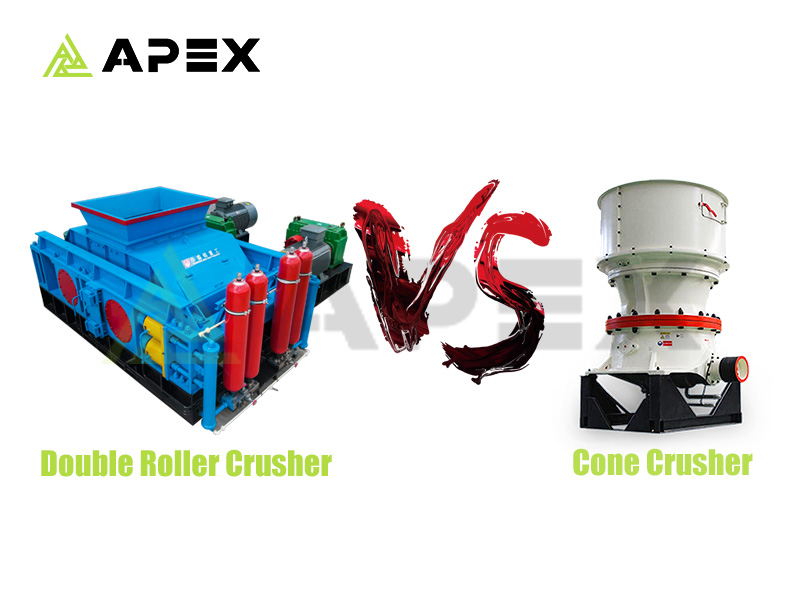
Double Roll Crushers vs. Cone Crushers: How to Choose the Right Fine Crushing Equipment for Your Plant
Does Decreasing the Roll Gap of a Double Roll Crusher Reduce Throughput? Performance Analysis & Solutions